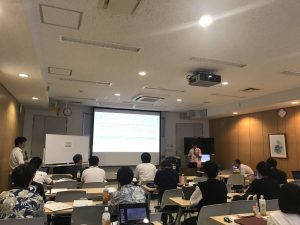
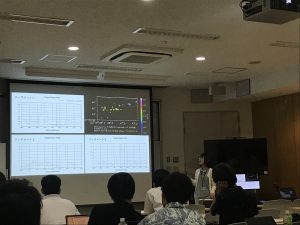
[Speaker]
Yoshiki Hatta
Affiliation:SOKENDAI 4th year (D2)
(Supervisor: Takashi Sekii, Hirohisa Hara, and Othman Benomar )
[Title]
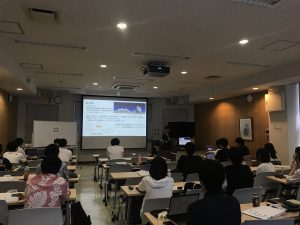
Progress report on modeling KIC 11145123
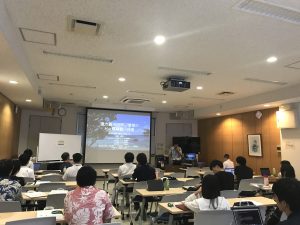
[Speaker]
Yoshiki Hatta
Affiliation:SOKENDAI 4th year (D2)
(Supervisor: Takashi Sekii, Hirohisa Hara, and Othman Benomar )
[Title]
Progress report on modeling KIC 11145123
国立天文台・総合研究大学院大学サマーステューデントプログラムが夏休み期間中に実施されました。
このプログラムは、大学理工系学部2年または3年に在学する学生が、8月から9月の間の2~4週間程度国立天文台に滞在し、受入教員の指導のもとで研究を行うことができる制度です。
天文学研究に強い意欲のある学生に研究の機会を設けることにより、将来、天文学研究を志す人材を育成することを目的としています。
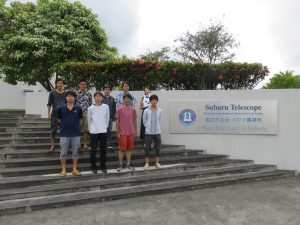
国立天文台の三鷹(東京都)、水沢(岩手県)、神岡(岐阜県)、ヒロ(ハワイ)及びサンティアゴ(チリ)のいずれか一つのキャンパスに滞在して研究を行い、研究受入期間最終日は国立天文台三鷹キャンパスで開催される合同発表会で研究成果を発表します。過去には、このプログラムの修了生が実際に総研大に入学した例もあり、学部学生にとっては大変貴重な経験が得られるプログラムとして定着しつつあります。
サマーチューデントの受け入れを希望する教員には研究指導内容のシラバスを提出してもらい、それをもとにして学生が希望する研究を選ぶことができます。教員は全部で37名。天文学の研究から装置開発まで非常に幅広い分野から選択できました。
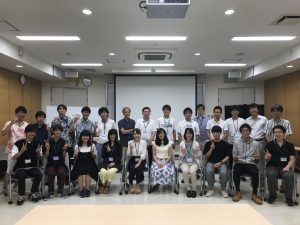
今年で9年目となる本プログラムですが、今年は22名の学生がサンティアゴ(チリ)、ヒロ(ハワイ)、神岡、水沢、三鷹など、国立天文台の様々なキャンパスで体験研究を行いました。
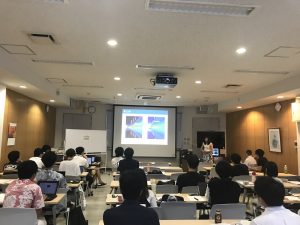
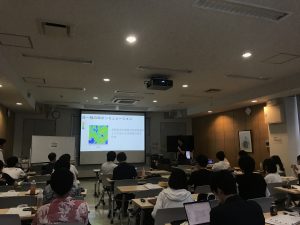
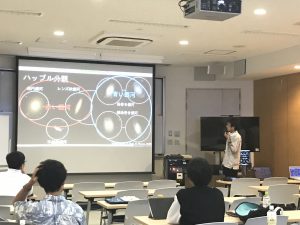
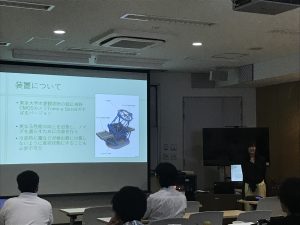
2019年9月3日(火)最終日には三鷹キャンパスにて成果発表会が開催されました。
(下記タイトルです)
「アルマで見た初期原始星に付随する分子流ジェット」
「惑星近傍での降着過程に関する流体シミュレーション」
「非一様な星間媒質を伝播する超新星爆発による衝撃波の3次元流体シミュレーション」
「ALMAによる遠方銀河のダークマター質量分布についての研究」
「若い星に付随する太陽系外惑星の探査および軌道について」
「構造を持った原始惑星系円盤の近赤外線観測」
「 HSC/SSPで探る近傍矮小銀河の恒星種族」
「HSC-SSP で検出された赤方偏移 0.4 の星形成銀河の性質と銀河内の星形成活動の分布」
「遠方銀河団周辺領域のHα輝線銀河探査」
「すばるHyper Suprime-Camを用いた遠方銀河団探査」
「すばる望遠鏡用高視野高時間分解能カメラの開発-真空冷却カメラの組み立てと性能評価-」
「すばる望遠鏡用高視野高時間分解能カメラの開発-CMOS検出器の総合性能評価-」
「ALMAによる近傍不規則銀河のガスダイナミックスの研究」
「テラヘルツ光子計数型検出器に向けた回路素子の評価」
「ミリ波サブミリ波検出器アレイのための広帯域オンチップMagic Tの開発」
「重力波検出器KAGRAにおける共振器のフィネス測定の自動化」
「原始惑星系円盤からの複雑な有機分子のスペクトル」
「ALMAで調べる活動銀河中心核の特異な輝線強度比」
「VLBIデータを用いたM87ジェットの収束構造の研究」
「VLBIデータを使った3C84ジェットの収束構造の研究」
「アルマ観測データを用いたNGC1275の研究〜銀河団と核周領域をつなぐ複雑なフィラメントの降着〜」
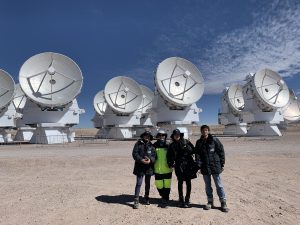
2〜4週間と大変短い研究期間でしたが、英語の文献を読みながら装置開発の基礎を学んだり、データ解析用のプログラムを書いたり、観測装置の仕組みを学んだり、大学の講義ではあまり触れない内容を経験することができました。また、チリの合同アルマ観測所でのプログラムに参加した学生は、アルマ望遠鏡の山麓施設を訪問し、実際のアルマ望遠鏡システムの見学を行い、観測の運用を体験しました。成果発表会では、初めての研究発表で少し緊張気味の学生もいましたが、みなさん研究成果をしっかりとわかりやすい資料にまとめて生き生きと発表していました。
伊王野大介(国立天文台アルマプロジェクト/総研大物理科学研究科天文科学専攻)、
青木和光(国立天文台TMTプロジェクト/総研大物理科学研究科天文科学専攻)
[Speaker1]
Tadafumi Matsuno
SOKENDAI 5th year (D3)
(Supervisor: Aoki Wako, Komiyama Yutaka, Tsujimoto Takuji)
[Title1]
Mass of halo stars from asteroseismology
[Speaker2]
Satoshi Tanioka
SOKENDAI 4th year (D2)
(Supervisor: Yoichi Aso, Ryutaro Takahashi, Tomotada Akutsu)
[Title2]
Thermal Noise from Icy Sapphire Mirrors
[Speaker]
Nao Fukagawa
SOKENDAI 5th year (D3)
(Supervisor: Tadayuki Kodama, Wako Aoki,Daisuke Iono, Masato Onodera)
[Title]
Constraint on the rates of gas inflow and outflow of star-forming galaxies around cosmic noon based on chemical evolution
[Speaker]
Masaki Yoshida
SOKENDAI 5th year (D3)
(Supervisor: Yoshinori Suematsu, Hara Hirohisa, Ryohko Ishikawa)
[Title]
Magnetic Energy Transport through Chromospheric Spicule Revealed with Lyman-Alpha Spectro-Polarimetric Observation